26 May 2014

The New York Review of Books: “Why We’re in a New Gilded Age”

It therefore came as a revelation when Piketty and his colleagues showed that incomes of the now famous “one percent”, and of even narrower groups, are actually the big story in rising inequality. And this discovery came with a second revelation: talk of a second Gilded Age, which might have seemed like hyperbole, was nothing of the kind. In America in particular the share of national income going to the top one percent has followed a great U-shaped arc. Before World War I the one percent received around a fifth of total income in both Britain and the United States. By 1950 that share had been cut by more than half. But since 1980 the one percent has seen its income share surge again—and in the United States it’s back to what it was a century ago.

Paul Krugman

While many talk about income inequality, its effects on economic recovery and the widening gap between the 1% and the rest, the book reviewed here has solid research on the subject based on economic data going back a century and more. It also lays out an easy theoretical solution: adjusting tax rates for capital returns and inheritance would improve income distribution considerably and slow further accumulation of capital in the same hands. Unfortunately, as you may imagine, it’s not so easy to apply this in the real world, where political decision-making is heavily influenced by those 1% it’s supposed to tax…

New Gilded Age Income Share graph

25 May 2014

Haruki Murakami - 1Q84

in Bucharest, Romania

Haruki Murakami - 1Q84Pe o autostradă aglomerată din Tokyo, în acordurile simfoniei lui Janáček, tânăra Aomame e nerăbdătoare să ajungă la o întâlnire importantă de afaceri, atât de nerăbdătoare că acceptă sugestia neobișnuită a șoferului de taxi de a părăsi mașina în mijlocul șirului încremenit de automobile și de a coborî pe o scară de incendiu pentru a putea prinde un metrou în schimb. Punctualitatea este crucială, căci altfel planul bine pus la punct pentru asasinarea unui om de afaceri în camera lui de hotel s‑ar da peste cap! În altă parte a orașului, Tengo, profesor de matematică cu jumătate de normă și scriitor aspirant, se întâlnește într‑o cafenea cu editorul său, Komatsu, care vine cu o propunere pe cât de tentantă, pe atât de periculoasă. Komatsu a descoperit un manuscris fascinant al unei tinere de 17 ani, Fuka‑Eri, despre care e convins că ar putea câștiga un prestigios premiu literar, cu condiția ca Tengo să șlefuiască ideile bune ale fetei cu stilul propriu care ei îi lipsește cu desăvârșire.
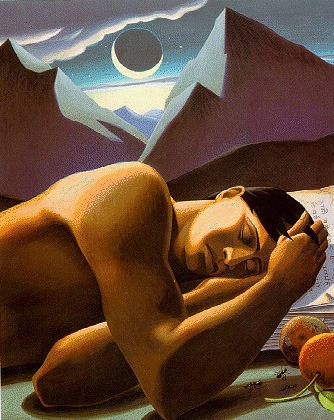
Romanul e structurat în trei părți, desfășurându‑se de‑a lungul a trei anotimpuri în anul 1984 – sau în cel alternativ 1Q84 dacă preferați. Mai departe ițele se încurcă considerabil: publicarea povestirii lui Fuka‑Eri, Air Chrysalis, atrage atenția unei grupări religioase misterioase, Sakigake, unde fata locuise până în urmă cu câțiva ani, și aceștia nu sunt deloc mulțumiți de atenția din partea presei și a poliției generată de popularitatea povestirii și apoi de dispariția autoarei. De cealaltă parte, viața secretă de asasină a lui Aomame o poartă încet, dar sigur, spre o întâlnire cu aceeași sectă, atunci când patroana ei bogată o îndeamnă să curme viața Leader‑ului Sakigake, nimeni altul decât tatăl lui Fuka‑Eri. În paralel cu evenimentele prezente se formează o imagine completă despre trecutul celor doi; un fragment conținând o parte semnificativă din copilăria lui Tengo poate fi citit gratuit sub titlul Town of Cats. Semne mici și mari dezvăluie de ce apar împreună în roman: între ei există o legătură veche de douăzeci de ani, de pe vremea când erau împreună la școală, unde s‑au îndrăgostit într‑o zi de decembrie sub razele reci ale lunii. Acum regulile nescrise din lumea 1Q84 par să‑i conducă în aceeași direcție, dar vor avea ei oare puterea să treacă peste obstacole și să‑și împlinească iubirea?

24 May 2014

Paris Review: “Gabriel García Márquez, The Art of Fiction No. 69”

100 years of solitude
The more power you have, the harder it is to know who is lying to you and who is not. When you reach absolute power, there is no contact with reality, and that’s the worst kind of solitude there can be. A very powerful person, a dictator, is surrounded by interests and people whose final aim is to isolate him from reality; everything is in concert to isolate him. Gabriel García Márquez

A must-read interview for fans of the recently deceased Nobel Prize winner. I was a little disappointed there was no mention of Chronicle of a Death Foretold, probably my favorite novel by García Márquez, but the interview covers a lot of the themes and inspiration behind his work, how his passion for journalism and fiction influenced each other, and how he approached writing and the process of fabricating reality with only a pen on a piece of paper.

23 May 2014

The New Yorker: “A Star in a Bottle”

Core Of The Sun by MurdocSnook on deviantART

Fusion, the most plentiful energy source in the universe, has never produced energy on Earth. Nature had shielded the planet from the punishing conditions it requires with a great buffer: millions of miles of empty space. What the physicists and the engineers in the South of France were attempting to do was to traverse that boundary. Thirty-five countries were trying somehow to cross it together. On some level, the arrangement would necessarily be a messy one.

Raffi Khatchadourian

Fascinating – and surprisingly long – article about ITER, the biggest technological project of our age, and the quest to harness the most efficient source of energy known to us, nuclear fusion. Depending on the outcome, it could become one of the biggest achievement of human science and engineering, the clean and cheap power source that would end dependence on fossil fuels, turn back climate change and open our way to the stars – or, if it fails, a testament to our inability to manage long-term, high-investment projects, to overcome political differences and misguided national pride. The people working on this project could become the heroes of the 21st century and I wouldn't be surprised if in a couple of decades we will be reading captivating novels about their work, the huge difficulties and immense satisfaction of seeing it all come together in the end.

21 May 2014

Game Oven: “Bounden on Android delayed”

In the Vine above are 7 devices all running the same compass app (ironically named Steady Compass) on Android. Yet, all compasses indicate that North is somewhere else. Unfortunately, this has nothing to do with electromagnetic fields confusing the compass; it has everything to do with the diversity of hardware inside these devices.

Eline Muijres

This reminds me of a funny moment last year, during a trip to northern Norway. I travelled there with a small group of photographers to see the northern lights. One evening we were out in a small city, trying to find North. I had my iPhone, another couple brought their iPhones and iPad along, two other people had Samsung smartphones. Both iPhones and the iPad pointed in the same general direction – after some calibration – whereas the Samsungs pointed somewhere entirely different. Being under open and relatively clear skies and with good knowledge of astronomy, it didn’t take long to recognize which devices had it right: those built by Apple.

20 May 2014

What’s new in Chrome 35

Among the customary low-key   releases, this one will be particularly hard to notice for regular users, with no major changes to the user interface or features. The relevant updates are mainly aimed at developers, from improved support for JavaScript standards to unprefixed support for Shadow DOM, CSS background blending, the Web Audio API and the ability for websites to override Ctrl+mouse wheel scroll events. The in-browser developer tools received a couple of updates as well, as described in this article.

An experimental feature, the so-called ‘Origin chip’, got a lot of attention lately, with people actively discussing the security merits and usability downsides to hiding the page URL by default and replacing it with a button displaying only the top-level domain. For now it’s not enabled by default, there’s a flag for this allowing users to try out different versions. Personally I find the change very confusing and I can understand the people pointing out that this move is only serving Google by driving more searches to their search engine: the Omnibox is converted into a full-time search box and the URL is revealed only when you click on the origin chip, very hard to discover for an average user who doesn’t closely follow the browser release notes. Maybe I just got used to the URL and the different layers of information it silently provides, but without it the address field feels empty and out of place, they could just as well remove it completely!

Chrome 35 with Origin Chip left of Omnibox Chrome 35 with Origin Chip on the far right

17 May 2014

CNNMoney: “The Bill & Warren Show”

They say success is getting what you want and happiness is wanting what you get. I don’t know which one applies in this case, but I do know I wouldn’t be doing anything else. I’d advise you that when you go out to work, work for an organization of people you admire, because it will turn you on. I always worry about people who say, I’m going to do this for ten years; I really don’t like it very well. And then I’ll do this.... That’s a little like saving up sex for your old age. Not a very good idea. Warren Buffett

This interview with Bill Gates and Warren Buffett is more than 15 years old – basically a relic from the stone age in Internet years – but nevertheless has many good conclusions and advice from two very successful business men. Well worth a read even now.

