31 December 2013

A short wish-list for future technology

With 2013 soon to be over, many people look back blasé or with admiration at the new technological developments of the past year; I prefer instead to think of new ideas, things I’m currently missing and would like to see incorporated into future products. So here is my current, albeit rather short, list:

Weather-dependent alarms

RiseAndShine - Weather Alarm ClockJust a month ago, the world was gearing up to watch comet ISON in its full glory – which unfortunately ended up pretty badly for the comet after being burned and shredded by the encounter with the Sun. I was also trying to find the comet in the morning sky before the perihelion passage, but the weather was not on my side. Each morning when I woke up it was cloudy outside, with no chance to see anything on the sky. So you see my problem: rather than having to wake up every time and go outside to check the weather only to discover it’s overcast, wouldn’t it be better if the alarm would only ring if it’s clear outside? Current smartphones certainly have the information required, but as far as I know there is no app connecting the two – feel free to correct me if I’m wrong. Maybe IFTTT or Google Now could build something like that. It would be useful outside the circle of amateur astronomers: imagine your alarm waking you up earlier when it snowed outside or when it’s freezing to give you enough time to make it to work or to your appointments!
And apparently someone already built an app like that, for iOS at least! I should try it out at some point.

29 December 2013

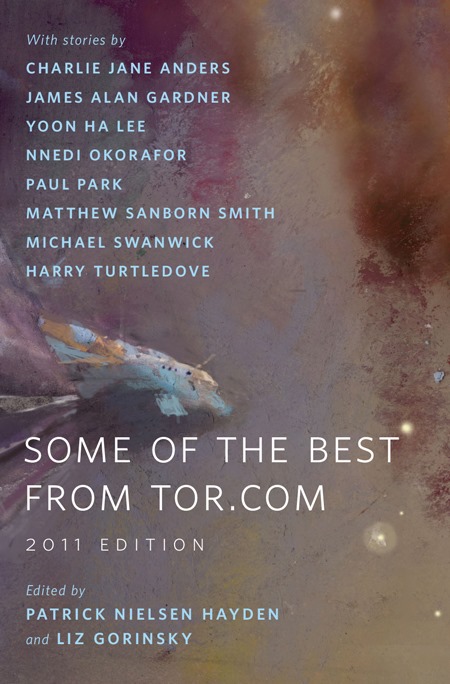
Some of the Best from Tor.com: 2011 Edition

in Bucharest, Romania

Some of the Best from Tor.com, 2011 editionApropo de editura Tor, am descoperit în revista Galileo colecțiile lor anuale de povestiri scurte SF, așa că le‑am descărcat pe cele pentru anii 2011 și 2012. Din păcate colecția pe 2011 nu m‑a impresionat deloc – poate doar neplăcut – și dacă astea chiar sunt cele mai bune povestiri ale lor mi‑e teamă că colecția pe 2012 o să rămână necitită…

Charlie Jane Anders – Six Months, Three Days

O poveste despre relația între doi clarvăzători, un el care percepe un singur viitor fix pentru întreaga lui viață și o ea care vede o multitudine de posibilități și încearcă să influențeze lucrurile pentru a obține cursul favorabil pentru ea. Evident, amândoi știu încă dinainte când se vor întâlni, cum va decurge și cum se va sfârși relația; el acceptă pentru că e singura opțiune pe care o vede, ea pentru că se așteaptă la o anumită revelație după despărțirea lor, care n‑ar apărea dacă nu ar trece prin cele șase luni și trei zile de relație. E o modalitate interesantă de a pune față-în-față două perspective vechi de când lumea, destinul și liberul-arbitru, dar cumva povestirea în sine nu convinge, personajele sunt prea fixate în propriile opinii și la final simți că nu ai aflat nimic nou, ci doar ai citit banalități dintr‑o relație eșuată – ba mai rău, una despre care toată lumea știa de la început că nu va funcționa!

There are a million tracks, you know. It’s like raindrops falling into a cistern, they’re separate until they hit the surface, and then they become the past: all undifferentiated.

28 December 2013

The Guardian: “Why have young people in Japan stopped having sex?”

Aversion to marriage and intimacy in modern life is not unique to Japan. Nor is growing preoccupation with digital technology. But what endless Japanese committees have failed to grasp when they stew over the country’s procreation-shy youth is that, thanks to official shortsightedness, the decision to stay single often makes perfect sense. This is true for both sexes, but it's especially true for women. Marriage is a woman’s grave, goes an old Japanese saying that refers to wives being ignored in favour of mistresses. For Japanese women today, marriage is the grave of their hard-won careers. […]

Around 70% of Japanese women leave their jobs after their first child. The World Economic Forum consistently ranks Japan as one of the world’s worst nations for gender equality at work. Social attitudes don’t help. Married working women are sometimes demonised as oniyome, or “devil wives”. In a telling Japanese ballet production of Bizet’s Carmen a few years ago, Carmen was portrayed as a career woman who stole company secrets to get ahead and then framed her lowly security-guard lover José. Her end was not pretty.

Abigail Haworth

Highly interesting article, even though there are plenty of other data and opinion contradicting it. I can’t pretend to be an expert on the matter, but I suspect the attitude towards marriage is a reflection of the relatively recent freedom of the society, an exaggerated reaction to the strict Japanese traditions. Now that these traditions are fading, people simply have more room to make their own choices in life, even if for some that choice means staying single and not having children.

The Wall Street Journal: “Do We Want an Erasable Internet?”

Yet, even if it fails, Snapchat will have been one of the most fascinating services to hit the Internet in years. To me, the app’s exploding popularity suggests that society is yearning for a new way to think about data. Snapchat is one of the first mainstream services to show us that our photos and texts don’t need to stick around forever: that erasing all the digital effluvia generated by our phones and computers can be just as popular a concept as saving it. Farhad Manjoo

Personally, I would prefer an Internet where things I share reach only the people I intended to share with, without having to worry that the service we’re using is recording that information to target ads or that the conversation is being scrutinized for possible threats by the NSA; an Internet where if I choose to delete something posted online it will be permanently deleted from all servers and not remain cached in a search log somewhere. But I’m not sure we’ll ever have that, the way things are going now…

27 December 2013

Hide apps from iPhone’s Purchased list

Using a smartphone usually means using apps, trying them out and discarding many as new ones are launched or better ones are discovered. If you need to restore some of the previous purchases, iOS makes it very easy: in the App Store’s Updates section you can click on the Purchased header to see a list of all your apps, and even filter for apps you have deleted by selecting ‘Not on This iPhone’. The problem is, as you try out and then remove more and more apps, the list becomes longer and longer, making it hard to find apps quickly. The list does have a search field, but it’s still annoying to see apps you are never planning to install again because you found better replacements (dozens of weather apps fit that profile), you stopped using the service (Path) or simply because the app has been discontinued (like Wavii).

22 December 2013

Goodreads: “2013 - Your Year in Books!”

Now that we’re nearing the end of 2013, we thought it would be fun to take a look at your year in books. Check out a visual representation of your reading year and reexperience everything you learned and felt over the past 12 months!

Suzanne Eskyvara

Speaking of reviews of the almost-finished 2013, Goodreads has a similar feature called ‘stats’ where you can compare the current year with the past in terms of number of books read, number of pages and ratings. Apparently I read 42 books during this year, a notable increase from 30 in 2012, but that’s mostly because I consumed a larger number of short stories. There are some books which I haven’t added here because they weren’t in the Goodreads database, so the numbers could be off by 2-3 books per year. A more accurate comparison of the volume is the number of pages read, where the difference between the two years is less pronounced. There’s no point comparing with 2011 because I only started using the site regularly somewhere at the beginning of 2012, after installing their app on my iPhone.

Susan Krinard - Freeze Warning

in Bucharest, Romania

Susan Krinard - Freeze WarningNavigând pe site‑ul editurii Tor după ce am descărcat de acolo câteva colecții de povestiri, am dat peste una care m‑a captivat prin copertă, așa că am trimis‑o imediat pe Kindle. Știu că nu e cea mai bună idee să judeci cărțile după copertă, dar de cele mai multe ori ăsta e singurul criteriu pe care‑l ai la dispoziție, pe lângă descrierea de pe spate. Freeze Warning e doar un preludiu la o serie mai amplă, un fel de episod-pilot pentru o trilogie inspirată de mitologia nordică. Mist este o valkirie trimisă în Midgard cu secole în urmă de însuși Odin pentru a păzi arma sa supremă, sulița Gungnir, în timp de zeii se înfruntă în bătălia finală, Ragnarok. Ca și suratele ei, după atâta timp fără nici un semn de la stăpânii lor, Mist se simte abandonată, cu o misiune lipsită de sens de vreme ce zeii au pierit probabil cu toții și nu vor reapărea să‑și ia în primire armele. Dar tocmai atunci când se hotărăște să îngroape sulița divină în apele Pacificului se întâlnește la docuri cu o bătrână încercând să se sinucidă și o salvează cu ajutorul unui străin chipeș și nobil, Eric Larsson, de care, evident, Mist se simte irezistibil atrasă.

Miturile vikinge se bucură de un interes larg din partea autorilor, de la benzile desenate adaptate în filme până la scriitori SF consacrați, așa că povestirea nu excelează prin idei originale. Autoarea se complace în câteva clișee care te fac să dai ochii peste cap cu iritare, ca de exemplu accesele de feminism ale lui Mist în Asgard, unde încearcă să convingă celelalte valkirii că merită mai mult decât să servească la banchetele zeilor și războinicilor din Valhalla. Totuși povestea are ceva farmec prin incertitudinea bine plasată față de soarta războiului și deruta perfect umană a lui Mist atunci când își vede scopul în viață pus sub semnul întrebării. Ba mai mult, am avut aproape imediat impresia că sub imaginea perfectă de războinic viking a lui Eric se ascunde Loki, venit să pună mâna pe arma aflată în custodia lui Mist – și din câte am citit mai târziu, se pare că am avut dreptate! Fără să fie o capodoperă, o povestire distractivă, fără pretențiile exagerate ale altora.

Nota mea: 3.0

disponibilă online pe site‑ul editurii Tor