Showing posts sorted by relevance for query label:Wave|label:Social. Sort by date Show all posts

07 November 2016

Rolling Stone: “Inside the Artificial Intelligence Revolution (Pt. 1)”

As for the dangers of AI, LeCun calls them “very distant”. He believes the notion that intelligent machines will evolve with the trappings of human intelligence and emotion is a fallacy: A lot of the bad things that come out of human behavior come from those very basic drives of wanting to survive and wanting to reproduce and wanting to avoid pain. There is no reason to believe robots will have that self-preservation instinct unless we build it into them. But they may have empathy because we will build it into them so they can interact with humans in a proper way. So the question is, what kind of low-level drives and behaviors do we build into machines so they become an extension of our intelligence and power, and not a replacement for it?

On my way out of Facebook, I’m struck by how densely packed everyone is in the office – this is an empire of human beings and machines working together. It’s hard to imagine the future will be any different, no matter how sophisticated our robots become. Algorithms are designed and built by humans, and they reflect the biases of their makers, says Jaron Lanier, a prominent computer scientist and author. For better or worse, whatever future we create, it will be the one we design and build for ourselves. To paraphrase an old adage about the structure of the universe: It’s humans all the way down.

Jeff Goodell

According to Silicon Valley, Artificial Intelligence is the next big frontier of technological advancement – even though nobody’s quite sure how to achieve it or if it’s good or bad. Every time I read another article brimming with excitement about how great things will be I stop for a moment and remember travelling to the country here in Romania. Once you step out of the larger cities, every village and road here seems disconnected from the hectic flow of the world. It’s next to impossible to imagine how any advance in AI could change these places where even the Internet has a marginal effect; at some level this puts these discussions into perspective.
27 May 2013

void Fox() Dev Blog: “Why the new Google Hangouts screws over users”

So in summary... Google has pulled the plug on support on a protocol they've helped popularize, after years of promising interoperability, for reasons that are dubious at best, and in a way that leaves people who don't jump to the new Hangouts app unable to talk to their contacts without any feedback that their IMs aren't getting through... and they've done that with no warning to anyone. I imagine there's a bunch of people out there wondering where some of their buddies have gone, or why their messages aren't getting responses, because this isn't documented anywhere. trysdyn

It’s a sad day for the Internet when  supports an open standard and doesn’t…

19 July 2016

Vanity Fair: “How Mark Zuckerberg Led Facebook’s War to Crush Google Plus”

Google Plus was Google finally taking note of Facebook and confronting the company head-on, rather than via cloak-and-dagger recruitment shenanigans and catty disses at tech conferences. It hit Facebook like a bomb. Zuck took it as an existential threat comparable to the Soviets’ placing nukes in Cuba in 1962. Google Plus was the great enemy’s sally into our own hemisphere, and it gripped Zuck like nothing else. He declared “Lockdown”, the first and only one during my time there. As was duly explained to the more recent employees, Lockdown was a state of war that dated to Facebook’s earliest days, when no one could leave the building while the company confronted some threat, either competitive or technical.

Antonio García Martínez

Flashy title, but the article itself describes very little about this so-called ‘war’ other than Mark Zuckerberg calling a high-priority, all-staff meeting. I guess the minutes from this gathering were pretty concise: ‘we’ll just sit back and watch Google shoot itself in the foot’.

02 March 2021

Los Angeles Times: “Clubhouse users spend hours on the app. What’s the appeal?”

Harfoush, a digital anthropologist and author who lives in Paris, is part of an “anti-grift squad” that helps newcomers to the audio-only interactive streaming platform avoid falling prey to scams.

She and a crew of veteran users dedicate hours each week to running free onboarding sessions for first-time users, and host a weekly room, or session, on the app to document some of the shady practices they see cropping up. Harfoush believes the intimacy of Clubhouse’s format — a cross between a conference panel discussion and a radio call-in show — makes even familiar scams more effective. We’re naturally more persuadable by hearing somebody talk to us than reading something, she said.


Users claiming to be business experts have run pitch rooms, Harfoush said, where they invite hopeful entrepreneurs to outline their dreams for a new business on stage, and then go register related domain names with the intent of selling them back to the hopefuls at a markup. Fake literary agents promise aspiring authors that they’ll edit their manuscripts and connect them with publishers, for an upfront fee.

Other users claiming to be music producers invite aspiring beatmakers to present their tracks live for critique, and then simply steal the tracks as their own. And motivational speakers are using Clubhouse as a new venue to convince anyone that they can learn how to become a millionaire — if only they pay thousands of dollars for an exclusive executive coaching seminar. Audience plants, fake time limits and other hard-sell tactics abound.

Sam Dean

I must be getting old because new social networks launch and… I feel absolutely no interest in joining them. After TikTok, now Clubhouse is booming since December – granted, I could not join Clubhouse even if I wanted too, because it is still exclusive to the iPhone. At first glance, it is quite literally a public conference call where other people can join and listen in – or alternatively unedited live podcasting. I have used Webex for the past couple of months while working from home and it has a feature called ‘Personal Rooms’ – add the public aspect and you get Clubhouse.

05 November 2016

The Guardian: “The sugar conspiracy”

The most prominent recommendation of both governments was to cut back on saturated fats and cholesterol (this was the first time that the public had been advised to eat less of something, rather than enough of everything). Consumers dutifully obeyed. We replaced steak and sausages with pasta and rice, butter with margarine and vegetable oils, eggs with muesli, and milk with low-fat milk or orange juice. But instead of becoming healthier, we grew fatter and sicker.

Look at a graph of postwar obesity rates and it becomes clear that something changed after 1980. In the US, the line rises very gradually until, in the early 1980s, it takes off like an aeroplane. Just 12% of Americans were obese in 1950, 15% in 1980, 35% by 2000. In the UK, the line is flat for decades until the mid-1980s, at which point it also turns towards the sky. Only 6% of Britons were obese in 1980. In the next 20 years that figure more than trebled. Today, two thirds of Britons are either obese or overweight, making this the fattest country in the EU. Type 2 diabetes, closely related to obesity, has risen in tandem in both countries.

Ian Leslie

Interesting article about the scientist who warned about the health issues excess sugar can cause decades ago – and was met with criticism and derision by his fellows. An unfortunate example where the scientific method takes the back seat to personal feuds and corporate interests in the food industry. The official bodies and the press are beginning to acknowledge the problem, but much of the damage has already been done.

04 July 2014

as days pass by: “Facebook and the button of happiness”

There is an undercurrent of fatalism in some of the responses to publication of this study. “Man, if you expect Facebook to do anything other than shove a live rattlesnake up your arse in pursuit of profit, you’re a naive child.” I don’t agree with that. We should expect more, demand more, hope for more from those who act as custodians of our data. Whether the law requires it or not. (European data protection laws are considerably more constraining than those in the US, in my opinion correctly, but acting only just as decently as the law requires is the minimum requirement, and we should ask for better.) But I honestly don’t see the difference between what Facebook did and what Target did. Yes, someone with depression could be adversely affected (perhaps very severely) by Facebook making their main channel of friendly communication be markedly less friendly. But consider if the pregnant woman who hadn’t told her father had had a miscarriage, and then received a book of baby milk vouchers in the mail.

Stuart Langridge

In case you didn’t hear about it, recently published a research paper based on careful manipulation of the newsfeed in order to investigate how the mood of the stories in the feed influences the emotions of users. And with it unleashed a seemingly endless wave of outrage on the internet. Personally I don’t see much reason to revolt; in our current media culture, we are exposed to high levels of manipulation in the news on a daily basis, constantly affecting our opinions about politics, science and a number of other subjects. The fact that our emotions are influenced by what people close to us are experiencing is just a sign of human empathy – people would likely react the same way if they found out about the sad or happy events through other channels, out of Facebook’s reach. So I largely agree with the article linked above, with one exception: I wouldn't be as eager to use the ‘happiness button’ as the author seems to be.

25 October 2013

Bishop Fox: “LinkedIn ‘Intro’duces Insecurity”

LinkedIn released a new product today called Intro.  They call it “doing the impossible”, but some might call it “hijacking email”.  Why do we say this?  Consider the following:

Intro reconfigures your iOS device (e.g. iPhone, iPad) so that all of your emails go through LinkedIn’s servers. You read that right. Once you install the Intro app, all of your emails, both sent and received, are transmitted via LinkedIn’s servers. LinkedIn is forcing all your IMAP and SMTP data through their own servers and then analyzing and scraping your emails for data pertaining to… whatever they feel like.

Bishop Fox

Redirecting private, sensitive, confidential information through another third-party. What could possibly go wrong?

01 November 2014

Google Wave and the uncanny valley of communication

Last week I saw a tweet wondering if Google Wave could have been successful, had it launched now instead of 2010. I suspect it was more of a rhetorical question, possibly hinting at the recent launch of Inbox, which was introduced in similar terms to Wave (the next evolution of email and invite-only rollout). For me, the answer is pretty clear: as much as I loved Wave, it was too complex to ever gain mainstream adoption. Real-time communication has since become the fastest growing segment of social media, but collaborative editing hasn’t taken off, and I can’t think of an app doing both successfully. The combination of features Wave offered would have had a hard time entering corporate space as well simply because companies are reluctant to radically change their existing systems. Some concepts have been adapted into other products – for example on Medium people can comment anywhere in an article, starting a local thread, although it’s unclear if that was inspired by Wave or just a similar idea developed independently.

06 January 2014

Vivaldi.net: “Farewell to My Opera”

I have no idea how many - or few - users are now actively blogging and sharing photos on My Opera, neither do I know how many users ever in the site’s history wrote at least one blog post, accepted one friend connection or created one album. It’s quite obvious that the site did not have the growth potential to challenge Facebook’s or Google’s head start - but I can’t possibly see how disrespectfully squandering all that trust and goodwill those thousands or tens of thousands of users held, will be good for Opera Software ASA in the longer term. Hallvord R. M. Steen

Another nail in ’s coffin. I suppose I should feel a bit nostalgic, after all I wrote my first ever blog post on My Opera, but… While I sympathize with the users who will see their content disappear or will have to struggle to move it elsewhere, My Opera was an inferior solution for blogging, filled with spam accounts and I won’t feel any regrets to see it shut down.

19 January 2013

Facebook Graph Search has potential, but lacks relevance

So this week it finally happened, a move many have expected for years: is getting serious about search! I don’t have access yet, it will be slowly and carefully scaled up from a limited start in the US (you can join the waiting list here, by the way), so I can’t say anything first-hand about the quality of the results, but some criticism comes to mind nevertheless. It’s not the first launch by Facebook that has the tech media crazy with headlines and how it will revolutionize or kill this or that competitor – Messages comes to mind – but in my opinion it’s unlikely to do that for several reasons:


Facebook Graph Search hands-on by The Verge

29 March 2022

Wired: “How Telegram Became the Anti-Facebook”

But over the past year or so, Mark Zuckerberg’s empire has begun to look a little less invulnerable. Lawmakers have increasingly arrayed against it, and at brief moments—like the January 2021 mass exodus from WhatsApp, and a second one that followed a Facebook outage in October—the powerful network effects that drive Meta’s supremacy have seemed to shift briefly into reverse. Somehow Telegram, with its tiny staff, has become one of the greatest beneficiaries of those stumbles.

Whether this is a good thing for the world is another question, one muddied by how poorly understood Telegram is, especially in the US. The vast majority of journalists still refer to it as an “encrypted messaging app”. This description unnerves many security experts, who warn that, unlike Signal or WhatsApp, Telegram is not end-to-end encrypted by default; that users must go out of their way to turn on the app’s “secret chats” function (which few people actually do); and that only individual conversations, not those among groups, can be end-to-end encrypted. For the millions of people who use Telegram under repressive regimes, experts say, that confusion could be costly.

But the term “messaging app” is itself somewhat misleading, in ways that lead many to underestimate Telegram. Over the years, the app has become a deliberate hybrid of a messaging service and a social media platform—a rival not only to WhatsApp and Signal but also, increasingly, to Facebook itself.


Its blend of private messaging and public channels makes it a perfect organizing tool: ideal for evangelizing in public and then plotting in secret. I call it the one-two punch, says Megan Squire, a computer science professor at Elon University in North Carolina who studies Telegram. You can do both propaganda and planning on the same app.

It’s been vital to pro-democracy protesters from Belarus to Hong Kong, but the global right seems to find Telegram particularly congenial. In Germany, a movement against Covid restrictions used the app to organize huge demonstrations in central Berlin in 2020, leading to the storming of parliament’s steps by a mob of extremists, in a sinister foreshadowing of January 6. (The stated aim of some protesters was to show Trump that they were ready for him to liberate Germany from a deep-state conspiracy.)

Darren Loucaides

I have always been somewhat skeptical of companies founded by Russians (including Revolut, which has grown quite popular here in Romania) – no matter how strongly they may deny connections to the Russian authorities, a repressive government could always find ways to coerce the company into complying with its demands, however illegitimate (same goes for Chinese companies). This extensive piece has only increased my apprehension; Durov’s admiration for Mark Zuckerberg, his cult-like status inside the company and outward secrecy, their (fortunately unsuccessful) forays into cryptocurrencies and almost complete lack of a sustainable business model, are all reasons to remain cautious of Telegram and its future. I personally like Telegram more than WhatsApp and similar messaging apps; it has a nicer interface and feels more well-built – probably owing to the Durov brothers’ background in mathematics and engineering – but everything else surrounding it feels shady.

05 February 2012

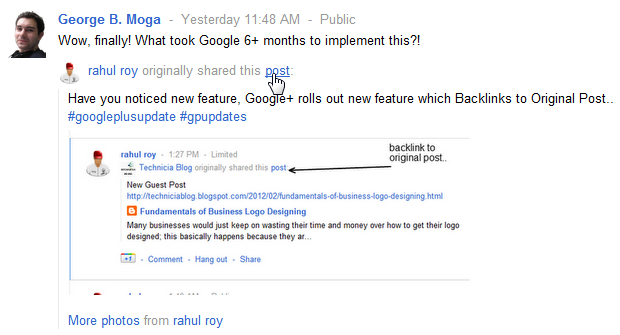
Links to the original post in Google+

For all the publicity and attention Plus got from day one, even becoming an integral part of your search results, some of the features one would think of as essential were missing. One perfect example was the lack of a link to the original post in the reshared ones. It not only breaks attribution, something that should be at the basis of the Internet, it’s bad user experience as well. You can’t easily access the posting being shared if you want to comment or +1 directly at the source; it gets especially bad when the one who reshared it disables comments and asks you to comment on the original – good luck finding it, if it’s an older post. And so there goes the user engagement that Google wants so badly!

But enough ranting, because there is not reason to anymore: since about a day ago, shared updates will have the important link to the original, as it was supposed to from day one. There was no official announcement as far as I can tell, so it’s probably still rolling out. And it’s possible that these links will appear only when resharing public posts, otherwise some privacy breaches may happen. Bottom line: Google still listens to users, at least when it’s in their best interest to do so. Google Plus sharing backlinks

21 June 2016

Variety: “Public: a Group Chat with an audience from the Founder of Boxee”

I believe messaging could be a third medium for broadcasting conversations, Ronen told Variety during an interview this week. It’s been around for decades on audio (radio and now podcasts) and video (TV and now YouTube). I believe messaging could be a third platform for conversations.

Public, which launched with an iPhone app and website Friday, can best be described as group chats with an audience. A few active participants chat with each other on a topic, be it “Game of Thrones,” a sports team or “Black Arts & Literature.” All these discussions happen in public, allowing anyone to follow them in real-time or read up on them later. And chats can be embedded on other websites as well as shared via Facebook, Twitter or Instagram.

Janko Roettgers

Wow, another Twitter-wanna-be app in the course of two months! Presented along more-or-less the same terms no less, as you can read below. Either people are expecting Twitter to fail really hard and want to take its place (but if Twitter fails, doesn’t that also mean it was a bad idea in the first place?) or are trying to grab a piece of its success (in which case they’re going to face an uphill struggle, especially since both apps are iPhone only).

21 March 2022

Ars Technica: “Americans want to be carbon neutral, don’t want to take needed steps”

Earlier this week, the Pew Research Center announced the results of polling that asked the US public its thoughts on how to address climate change. While the usual partisan split was apparent, the survey highlights an even larger challenge that policymakers will face: the US public supports contradictory things when it comes to climate policy.

Nearly 70 percent of the public favored taking steps toward the goal of being carbon neutral by 2050. Yet less than a third support transitioning off fossil fuels.


There are some obvious problems here with people not having a firm grip on reality. People still don’t think humans are causing climate change, or they somehow refuse to recognize that reducing fossil fuel use will lead to cleaner air. But those have been issues for a while, and the people who believe those things are unlikely to support a pathway to carbon neutrality anyway.

The larger problem is that even the people who claim to support putting the US on a path that leads to carbon neutrality don’t seem to realize the sorts of changes it requires. Given that, many of them are unlikely to support the policy changes that are needed to get there.

John Timmer

Climate policy is far from the only topic where the broader public wants certain outcomes, but is unwilling to contribute to the solution, or is supporting measures that would exacerbate the problem. Take the pandemic: I think everyone can agree that we wish it to be over, but many are perfectly content to shift the burden of ending the pandemic onto others by denying to vaccinate or wear masks, arguing that their personal risks are low. Or the war in Ukraine: many are up in arms for the US government to intervene and enforce a no-fly-zone, ignoring the potential for rapid escalation of hostilities; others advocate for more sanctions on Russian oil and gas imports, but balk at paying higher fuel prices. A similar dynamic seems to be plaguing housing policy in the US, though I admit I have only read about it superficially.

30 May 2015

buffersocial: “6 Powerful Communication Tricks of Great Interviewers”

Remember that dreaded lull we talked about earlier? Sometimes – just sometimes – it can be a useful communications tool.

When a pro interviewer feels a subject is holding something back on a particular topic, they’ll often use the power of silence at the end of the answer to draw out more information.

Here’s how journalist Jim Lehrer describes it:

If you resist the temptation to respond too quickly to the answer, you’ll discover something almost magical. The other person will either expand on what he’s already said or he’ll go in a different direction. Either way, he’s expanding his response, and you get a clear view into his head and heart.
Courtney Seiter

I usually don’t pay attention to these kind of articles, but this one was interesting, particularly the section quoted above – because it’s something I often noticed myself in conversations.

17 February 2015

The New York Times: “Aiming to ease App Discovery, Apple pairs with Pinterest”

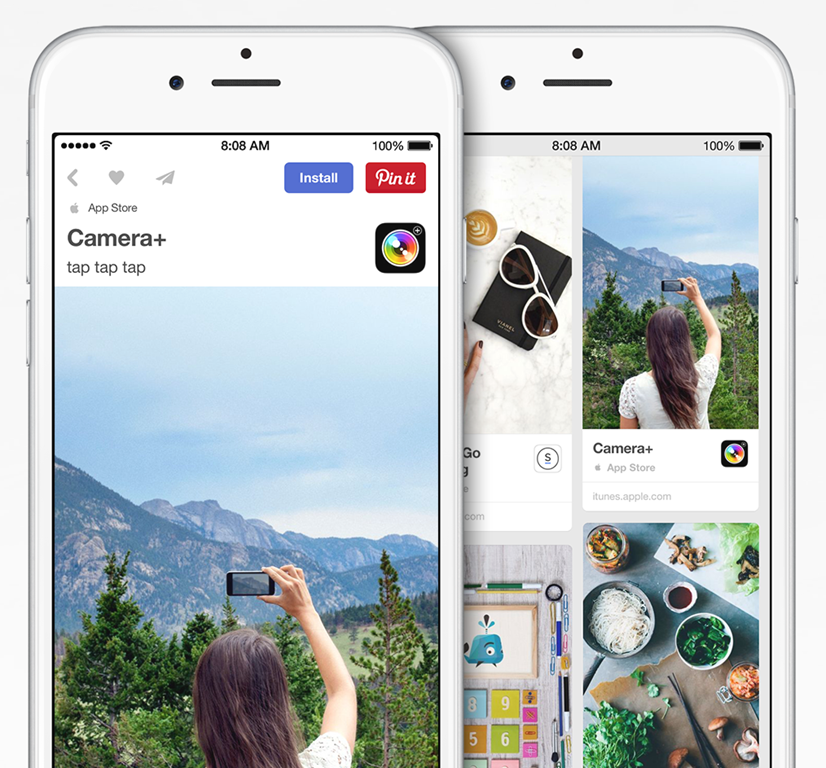
Pinterest App Pins

Unless you have a good idea of what you’re looking for, it can be tough to stumble upon novel, surprising items among Apple’s sprawling garden of apps.

Pinterest, the popular social bookmarking start-up, thinks it has a fix for this. The company is unveiling a new product on Thursday that could make it easier for people to discover new smartphone apps without even having to go into Apple’s App Store.

The product, called App Pins, aims to do the same thing for smartphone apps that Pinterest’s service has done for photos, recipes and many other types of websites. In short, the service is a type of digital corkboard that lets visitors save, or “pin”, items they like or places they want to go.

Mike Isaac

A strange collaboration, to say the least. While it’s growing fast (in the US at least), Pinterest is still largely preferred by the female audience, so it’s reach among customers will remain limited. As other tech giants, had its share of problems trying to bring a social component to its services. It added and integration to iOS, only to restrict them later; currently you can still ‘like’ apps in the store, although I’m not sure the action registers anywhere anymore. I expect this new partnership to end in the same muddled results.

Granted, I don’t know much about how Pinterest boards work, but to me it seems App Pins simply replicate Apple’s curated sections outside of the AppStore, offloading some of the app curation work on Pinterest users. This isn’t an improvement in app discovery, just another place to find apps… – not to mention how much easier it becomes to ‘recommend’ low-quality and spam apps.

14 March 2012

JW on Tech: “Why I left Google”

As it turned out, sharing was not broken. Sharing was working fine and dandy, Google just wasn’t part of it. People were sharing all around us and seemed quite happy. A user exodus from Facebook never materialized. I couldn’t even get my own teenage daughter to look at Google+ twice, social isn’t a product, she told me after I gave her a demo, social is people and the people are on Facebook. Google was the rich kid who, after having discovered he wasn’t invited to the party, built his own party in retaliation. The fact that no one came to Google’s party became the elephant in the room.James Whittaker

This story has been circulating a lot on the Internet lately and with good cause. Coming from a former Google who returned to his previous employer (Microsoft), it serves as insider confirmation for the criticism against the direction Google took lately, breaking user expectations, breaking good products, trying to force a new sharing model that simply doesn’t work.

You probably know the saying: If four or five guys tell you that you’re drunk, even though you know you haven’t had a thing to drink, the least you can do is to lie down a little while. Google got drunk on the idea it can do anything and doesn’t want to let it go, no matter how many people tell it otherwise.

06 July 2024

Platformer: “Adam Mosseri on the first year of Threads”

But my hope is that whether using Threads or Instagram or Twitter or Tik Tok or YouTube, or whatever it is, that reach is not an end, but it is a means to an end. Because ideally, you are clear with yourself about what you’re trying to get out of the platform. Are you trying to sell tickets to your gigs because you’re a musician? Are you trying to advance a cause because you’re an activist? Are you trying to just raise awareness around your art if you’re an artist?


That said, we do care about reach, we do try to grow reach. My advice is — and I think what a lot of people don’t realize, because a lot of people are coming over from Instagram — they don’t realize how important the reply game is. If you’re really trying to grow your presence, you should reply much more than you post. And the sum of all your replies is about as valuable as the sum of all the value of all your posts.

When people treat it, like, I’m just going to post and then move on with my day and then post again in a couple days and move on with my day — that’s not what it’s designed for. If it was for that, we wouldn’t have built it as a separate app — we would have built it in Instagram. But we built it so that the reply was as important as the original post — so that you could facilitate, when you’re lucky, these great conversations, which by the way helps with discovery.

Casey Newton

So… the secret recipe for reach on Threads is to become a ‘reply guy’?!

03 May 2018

Om on Tech: “Dating with Facebook: What’s love got to do with it?”

It is hardly a surprise that they will attempt dating — it increases time spent on Facebook, it brings a new flavor of addiction. Take a step back and remind yourself of Facebook’s attempts to bring you news ended in fake news becoming the norm. Their algorithms created not friendship but hate bubbles. And now the same company will create an algorithm of love?

However scratch the surface, and you start to see that this is Facebook being Facebook. They are addicted to collecting personal data, and what better way to get people to share their intimate details wants and desires by creating a tool that promises the elusive love, or more realistically, a date. When you are in dating mode, you are more likely to reveal a lot more intimate details.

Om Malik

Pretty bold move for Facebook to announce this in the middle of one of their biggest privacy scandals. I guess they’re confident most people have a short memory – and they might be right! Still, it doesn’t guarantee success by any means; Facebook launched so many copycat products over the years that it’s hard to keep track of them all – and very few managed to break out. Facebook’s biggest success story in fact, Instagram, was the result of an acquisition.

14 February 2011

What I expect from Google Me (2)

Better control over privacy and the news feed

Facebook runs on a very stiff, crude model of what people are like. It herds everybody — friends, co-workers, romantic partners, that guy who lived on your block but moved away after fifth grade — into the same big room. It smooshes together your work self and your home self, your past self and your present self, into a single generic extruded product. It suspends the natural process by which old friends fall away over time, allowing them to build up endlessly, producing the social equivalent of liver failure. On Facebook, there is one kind of relationship: friendship, and you have it with everybody. You’re friends with your spouse, and you’re friends with your plumber. Lev Grossman’s profile on Mark Zuckerberg for Time

Much has been said about the (in)ability of Facebook to model real-life human relationships or that they should allow unidirectional connections – the ‘follower’ model – like Twitter. Not to mention the convoluted and ever changing privacy settings. In my opinion, a system with three levels of privacy would be more flexible, while remaining relatively easy to manage:

  • The inner circle – friends: this would hold your real-life friends, people you trust and communicate with often. Naturally it will contain a small number of people, but they would have access to pretty much everything you do on the network: your real-time location, your current and future events, are allowed to tag you in photos and can see them, have access to your full contact details, can chat with you, add you to groups, etc. This will basically function like the early-days , a private network with people you actually know and want to actively keep in touch.

  • The outer circle – connections: containing more casual connections, people you worked with or members of the same club or gym, old friends you no longer keep in touch with, it should have tighter default privacy controls. People on this level can only see some of your contact details – no home address or phone numbers, maybe only one more generic email address, location restricted to city-level and events to free/busy indicators; if they tag you in photos you should be able to approve the tags first. And I wouldn’t mind an option to prevent them from inviting me to play games or use apps. This could become similar to LinkedIn or to the present-day Facebook, but without limits on the number of connections you can add.

  • The public realm. Here the two-way connection would be replaced by the follower model to create a network similar to or FriendFeed, where you could follow people with similar interests, publicly share links and status updates and comment on them.

The profile should also reflect the three privacy levels: display everything for friends, less information for connections and even more closed for the public; at this level users could also be allowed to replace their real name with a pseudonym.