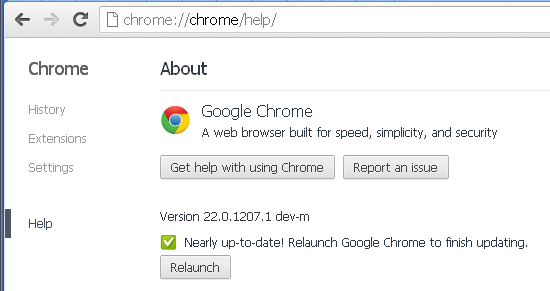
The web-based ‘About’ page first introduced in version 19 has become the default, replacing the previous modal dialog for updates. It’s now fully functional, providing a progress indicator for updates as well as links for help and reporting issues.
The web-based ‘About’ page first introduced in version 19 has become the default, replacing the previous modal dialog for updates. It’s now fully functional, providing a progress indicator for updates as well as links for help and reporting issues.
This week the first pieces of our work will land in mozilla-central, the primary Firefox development repository. The user experience will roll out one step at a time. First, we’ll offer an easy way to recommend things that you discover on the Web. Next, we’ll add support for notifications coming from the service and, once that’s landed, we’ll start on integrated news feeds and chat.
Johnathan Nightingale
Didn’t we go down this road before with Flock and later RockMelt? And if you don’t know what these names mean that just proves my point.
There is also talk about developing a Social API to provide the back-end for these actions in the browser. I’m not sure how is this supposed to work; will it have support from the major social providers Facebook and Twitter? Since both companies are under pressure to monetize their networks, what can Mozilla bring to the table, being a non-profit organization mainly financed by Google? The search giant might join, given their investment in Firefox; on the other hand Google has its own product to tend to, so if Google+ integration is coming to any browser, it will most likely be Chrome. As things are standing now, this project is as dead as the FirefoxOS.
via Sören Hentzschel

Când a ajuns la capitolul despre estetică, nu mică i‑a fost mirarea să vadă că, după părerea autorului,orice formă artistică este liebeswerbung. Adică seducere. Cu alte cuvinte, expresia publică a dorinței sexuale.
Destul de curând descoperi însă că cele mai multe dintre aceste amintiri au o componentă sexuală destul de marginală, așa că nu vă așteptați la cine știe ce scene toride de sex. Sunt mai mult niște întâlniri întâmplătoare și situații jenante, greu de înțeles pentru pre‑adolescentul Shizu, deși la un moment dat afirmă orgolios că nu e atât de neștiutor pe cât îl cred ceilalți. Interesul lui e axat în principal pe studiu și în majoritatea ocaziilor îl găsesc mai degrabă ferindu‑se de sexualitate decât căutând‑o. Chiar și așa descoperim multe despre aspectele sexuale ale societății japoneze: cărțile pornografice chinezești din care probabil a apărut hentai și poveștile idealizate de iubire, varianta orientală a romanelor siropoase de gen Sandra Brown, inevitabilele și faimoasele gheișe, ritualurile de curtare în vederea căsătoriei, împotriva cărora Shizuka se revoltă într‑o manieră egalitaristă pentru că nu oferă femeii aceleași drepturi de alegere ca și bărbatului, tratând‑o mai mult ca pe un obiect sau sclav decât ca pe o persoană.

I was never a big fan of listening to audio-books and podcasts – I find it silly to just sit around waiting for the information to play and very much prefer to read it at my own pace – but that started to change after purchasing my iPhone. I can’t say I am a big podcasts consumer even now, with only three subscriptions, but I do fire up the Music app occasionally to check out new science-fiction book reviews or opinions on the smartphone market. Needless to say I was intrigued by the decision to split podcasts into a separate app for the next version of iOS and decided to try it out.
At first, the app surprised me in a good way. My biggest fear was that the new app would not pick up the podcasts episodes already on my device and make me re-download them. That didn’t happen, fortunately; it seamlessly recognized existing podcasts so I could start using it right away. I turned on ‘Subscription’ and ‘Auto-Download’, sorted the episodes list by newest first and set the app to remove content after playing it – the ideal setup for me. It looked like a better, more feature-rich, app, even though I was unlikely to use some of them – like the hidden control to put the app to sleep after a chosen interval. It has the same level of integration with the audio controls as the Music app, so you can easily switch episodes from the lock screen or from the multitasking bar.
At the heart of Curiosity there is, of course, a computer. In this case the Mars rover is powered by a RAD750, a single-board computer (motherboard, RAM, ROM, and CPU) produced by BAE. The RAD750 has been on the market for more than 10 years, and it’s currently one of the most popular on-board computers for spacecraft. In Curiosity’s case, the CPU is a PowerPC 750 (PowerPC G3 in Mac nomenclature) clocked at around 200MHz — which might seem slow, but it’s still hundreds of times faster than, say, the Apollo Guidance Computer used in the first Moon landings. Also on the motherboard are 256MB of DRAM, and 2GB of flash storage — which will be used to store video and scientific data before transmission to Earth. Sebastian Anthony
So basically last year’s smartphone (given the right software) could control the spacecraft and guide it through the atmospheric entry procedure without breaking a sweat. Really puts into perspective how much some technologies, in this case computing, have evolved, while in other areas, like propulsion, space exploration remains stuck in the middle of the 20th century. With cheap propulsion and a light-weight launch system there could be an entire fleet of smartphones zipping around the solar system, orbiting all the major planets, landing on the moons, keeping tabs on near-Earth asteroids and doing deep-space interferometry. And probably so much more.
And, on a related note: Android Phones Will Power NASA's New Fleet of Mini-Satellites.
In a trio of product timelines submitted into evidence and released to the public on Friday as part of the company’s case against Samsung, Apple tracks the evolution of Samsung’s smartphone and tablet designs against those of the iPhone and iPad and hammers home its view that Samsung “slavishly” copied them both. Above, the iPhone timeline; below the iPad timeline; and to the right, a smartphone timeline. John Paczkowski

Samsung’s defense should go like this: “You know, we didn’t always copy the iPhone design, we also used to copy Nokia back when they were the market leader and still cool. We always copy from the best!”
Three simple numbers that add up to global catastrophe - and that make clear who the real enemy is
The Third Number: 2,795 Gigatons
This number is the scariest of all – one that, for the first time, meshes the political and scientific dimensions of our dilemma. It was highlighted last summer by the Carbon Tracker Initiative, a team of London financial analysts and environmentalists who published a report in an effort to educate investors about the possible risks that climate change poses to their stock portfolios. The number describes the amount of carbon already contained in the proven coal and oil and gas reserves of the fossil-fuel companies, and the countries (think Venezuela or Kuwait) that act like fossil-fuel companies. In short, it's the fossil fuel we're currently planning to burn. And the key point is that this new number – 2,795 – is higher than 565. Five times higher.
Bill McKibben
Extremely long article for an extremely difficult problem that will keep humanity busy far into our future. It’s one of those cases where both the market economy and governments (be it a democracy or a more centralized regime) fail to act in the best interest of us. It’s somewhat similar to the recent financial crisis in that few people and companies hold a lot of power and have a lot to gain from the status quo in the short term, at the expense of the majority; so making the necessary changes is proving extremely hard.
One of those articles I prefer to read on my Kindle.